Hands-on art at CUNE “declares the glory of God”
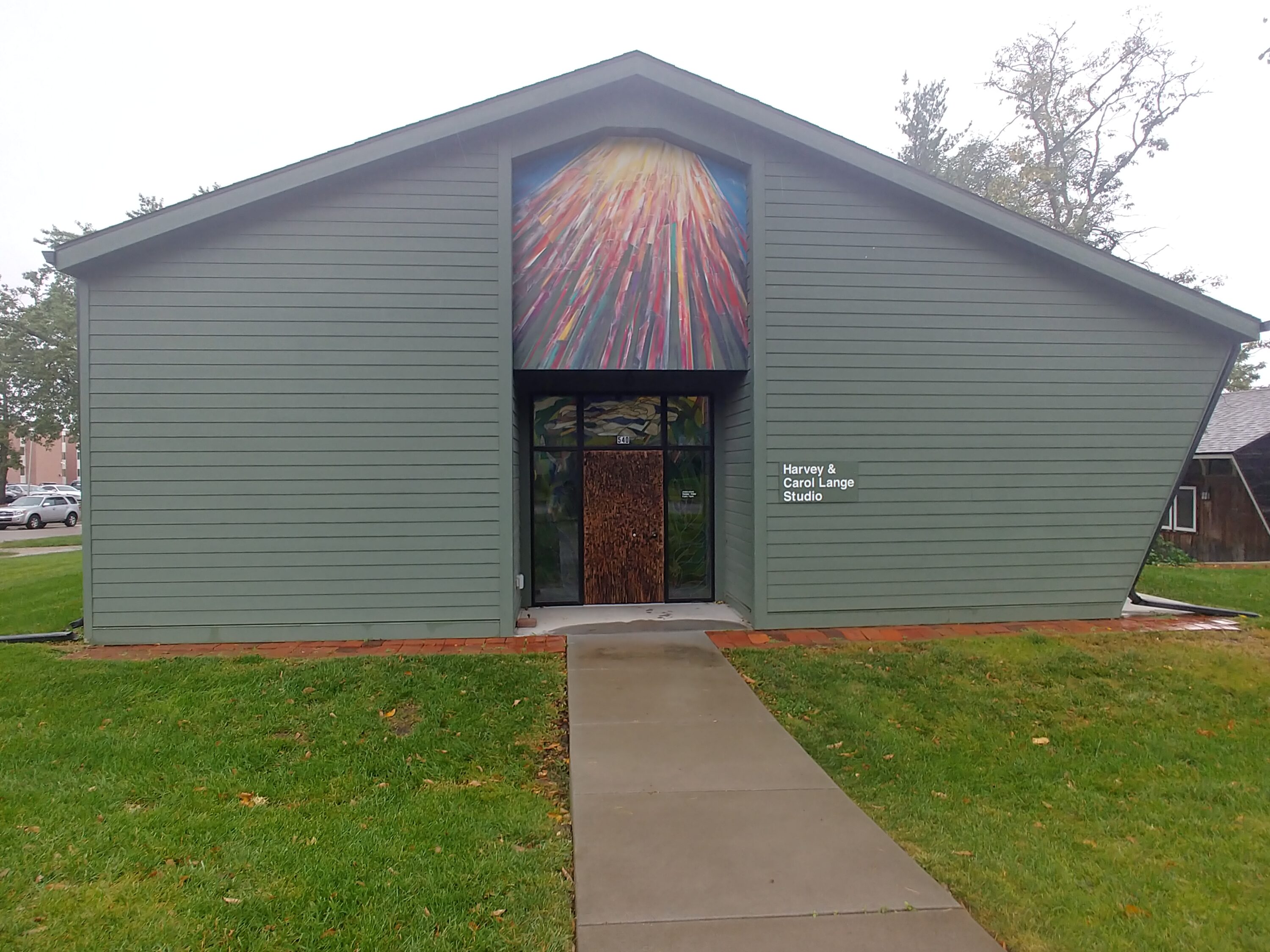
Concordia’s Center for Liturgical Art on the corner of N. Columbia Avenue and Lincoln Street.
Photo credit: Josiah Horvath
By Josiah Horvath
Housed in the little green building at the corner of campus, Concordia’s Center for Liturgical Art has served as an intermediary between the university and the world for two decades, employing student workers, connecting clients with talented artists, and serving as a witness of Christ’s love and the beauty of God’s creation.
The artists of the CLA engage in evangelism, according to Justin Groth, a Concordia art professor. He said these artists seek to point to a God who loves the world and life and possesses a “unique interest” in the details of His creation.
“Continue putting into the world little physical objects that declare the glory of God,” Groth said. “Objects that declare there is a God worth celebrating [and] praising [such as by] spending time and physical effort on making things.”
The CLA began with a vision formed jointly through conversations between Reinhold Marxhausen, an art professor, and Harvey Lange, a theology professor in the 1960s, said CLA Director Michael Scheer. Even so, it wasn’t until 2003 that the CLA as an institution was founded, and not until 2017 that it came to have its own space.
Today the CLA connects “churches, schools, hospitals and other organizations that are in need of liturgical art with artists that can do the work,” said Scheer. The CLA acts as an intermediary between its guild of artists and its clients, since the artists do not work for the CLA but for the clients.
The artist guild covers a variety of different mediums from stained glass to fabric, mosaic and more. Whatever the client needs, the guild can provide across their specialties.
“We do not allow guild artists to be students,” Scheer said. “Students who have worked with us in the past are now guild members now that they have graduated.”
While students are not guild artists, Scheer said the CLA does employ student workers, depending on what jobs are available. If artists work on their projects at the CLA studio on campus, they can utilize help from students.

Timothy Baker with the ceramic communion ware created at the CLA for the National Youth Gathering this summer. Photo: Timothy Baker.
“I learned so much from my experiences working for the CLA, both about slip-cast ceramics and perseverance,” said junior Timothy Baker.
He and a few other students worked this summer with Groth, who is a guild member, in making communion ware for the Lutheran Church—Missouri Synod Youth Gathering in New Orleans.
“Pottery is a process riddled with failure: it is a given that things will break at every step of the process and have to be scrapped,” Baker said. “But what a great sight when all 525 pieces were sitting finished on the shelf!”
There were a total of 175 communion sets, including chalices, patens and flagons.
Senior Keegan Biesel was another student who worked with Groth this summer in making communion ware, which she described as an involved process.
“This involved pouring clay into molds, taking [them] out of the molds, cleaning up the rough edges, firing the items in the kiln, painting on colored underglazes and dipping [them] in clear gaze, firing [them] a second time, and preparing the completed items for packaging and transport,” she said.
Beisel appreciated the opportunity to make something that would carry Christ’s body and blood.
“The Center for Liturgical Arts is an important part of the work that God is doing in His Church here in Seward, in the places where the works are sent, and in the lives of the artists who made them,” said Beisel.
She said the CLA gave people the chance to use their God-given gifts to make “beautiful and meaningful” artworks which “point back to Christ.”
Groth said that creating art is essential for cultural heritage, such that generations beyond our own can enjoy our works, as the generations before us have.
“I truly believe in the mission,” said Groth. “We need centers that make culture. We need centers that are actively engaged in the world bringing beauty to it.”
The Center for Liturgical Art is celebrating its 20th anniversary this year. This celebration includes a silent auction that began on Oct. 6, featuring the works of art faculty, emeriti and friends of the CLA.
On Oct. 10 on the second floor of Thom, there will be a dedication ceremony for 12 mosaics made by Marxhausen that newly adorn the hallway, each portraying one of the twelve apostles. The mosaics were originally at St. John Lutheran School in Forest Park, Ill. There was a mosaic for each of its classrooms. When that church closed the school, the mosaics were donated to Concordia Nebraska.
The mosaics underwent restoration work to ensure “that we respected the quality of Reinhold Marxhausen’s original work,” said Scheer.
“They underwent restoration work from us [the CLA] for a couple of years, making sure that they were at the quality that they needed to be,” he said. “And during that time we also were trying to find a site for them to be placed permanently.”
Following the dedication ceremony, there will be an open house for the Harvey and Carol Lange studio in the CLA from 1 p.m. to 4 p.m. on Oct. 10.