Where are seniors heading next?

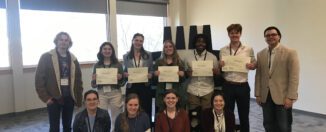
Seniors make post-graduation plans, including full- or part-time jobs, internships, rostered church work, and graduate school.
Photo credit: Nora Betts
By Elizabeth Salo and Mi-Ree Zwick
This article is featured in the April print edition of the Sower newspaper.
CUNE offers dozens of undergraduate majors and programs, giving students many options for serving the Church and the world, but depending on the job market and preferred locations, getting the positions they want after graduation can be challenging.
Senior graphic design major Lily Beck has had trouble finding a job because the market is very competitive, with jobs in her field often requiring three to five years of experience. She has not found a lot of available entry-level positions.
Simon Blankenship, a senior geography major, has faced similar issues, though with smaller experience gaps. He emphasized that geography is not the problem, but rather the current job market environment.
“If you look at [job postings], they want one to two years of experience on anything that pays well that’s permanent,” said Blankenship. “Any senior, and a lot of young adults I know who aren’t geographers are facing the exact same problems. It’s just the market; it’s a very tumultuous time for young adults in America.”
Hayley Miles, a senior biology major, looks forward to the internships she is planning, as they will help her gain experience and settle on a permanent job.
She currently has a temporary position secured for May to October, and noted that for many of her peers, the biggest challenge has been finding jobs in areas where they would like to live.
Senior psychology and criminal justice major Autumn Consier also is having difficulty finding a job in her degree area, but said it mostly was due to the geographical area in which she wants to work, and that most of the students in her majors were having better success, especially those seeking to go into law enforcement.
The job search is different for church workers, like senior church music major Rachel Brinkman. As a future rostered church worker, Brinkman worked with CUNE to go through the process of receiving a call. She currently has a call, and is waiting to finish school so that she can become an official rostered church worker and formally accept it.
Dr. Andrew Langewisch, a professor of business administration, said he is confident that Concordia graduates are properly prepared for real- world jobs, especially once they get past the entry-level market.
“Chances are, your first position is not your last,” said Langewisch. “So, if a person is in kind of an entry-level position, and then after a couple of years they switch to something else, are they better suited to the training they had here at Concordia? Probably yes.”
Langewisch also emphasized the importance of internships, even when they are not required for your major.
Senior Kiera Moses is majoring in elementary education and also studying language arts and math for middle school students. She doesn’t have a position lined up for after graduation, but she is in the process of interviewing for jobs. Moses said a shortage of teachers in both Lutheran and public schools makes it fairly easy for education majors to find jobs and that Concordia does a great job of preparing education students for their future careers.
“Concordia has a fantastic education program with amazing professors, and interviewers know this,” said Moses. “Lean into this and know that we are trained and taught well. Wherever you end up teaching, God has placed you there with purpose and on purpose to be a light to the students, the staff, and the community.”
Senior elementary education Caroline Beck, who is also receiving her Lutheran Teacher Diploma, has plans that are different from the typical education pathway.
She is interviewing to teach overseas with Mission of Christ Network, but she said that many of her peers are either student teaching, or already have calls for next year.
Kayla Korb, a senior theology and Christian Education Leadership student in the Director of Christian Education program, said that she will have an internship next year, and then will either receive a call, like Brinkman and many education majors, or be placed on a call list for churches looking for a DCE.
Korb said that many of her Lutheran Church–Missouri Synod peers in theology plan to attend seminary to become pastors or deaconesses, and those who are not LCMS typically plan on working for a church in some capacity.
Concordia has many other programs besides church work, and senior Josiah Edwards is majoring in journalism in hopes of working in journalism-related human resources. Edwards has interviewed for a job near his home in California, but he is still waiting to hear back.
He said that some of his peers in journalism majors, both at Concordia and at other universities, are planning on going into more traditional journalism, but some graduates have ended up in other jobs, such as public health.
Senior Taylor Larsen is a business and marketing major but said she has accepted a job as a dance coach for Lincoln High School.
Larsen said that it was difficult to find any marketing jobs that did not feel like a scam. She is hoping that Lincoln has job openings in marketing once she graduates.
Larsen is not alone. Senior business administration major Cylee Jameson has a job with Eagle Distributing as a part of the human resources team as a recruiter. Jameson said that she got this job through connections via a professor.
“I think in the career field we have it backward a lot of the times,” said Jameson, adding she thinks students should know what career they want to pursue before they commit to an education for a certain field. She said that many of her peers are seeking out experience to see what jobs may look like and have not yet figured out what they want to specifically pursue in a career.
Jameson said students should take the initiative when approaching potential employers, calling the company or even showing up in person. She said networking is extremely important because there are many companies looking for specific skill sets.
Some graduating seniors, rather than focusing immediately on their career, are looking at additional education. English and History major Adah Pflughoeft plans to pursue a master’s degree at a graduate school. She hopes that eventually she can teach English at the college level and possibly get some of her creative writing published.