Concordia profs share research on Seward home, early Black settlers
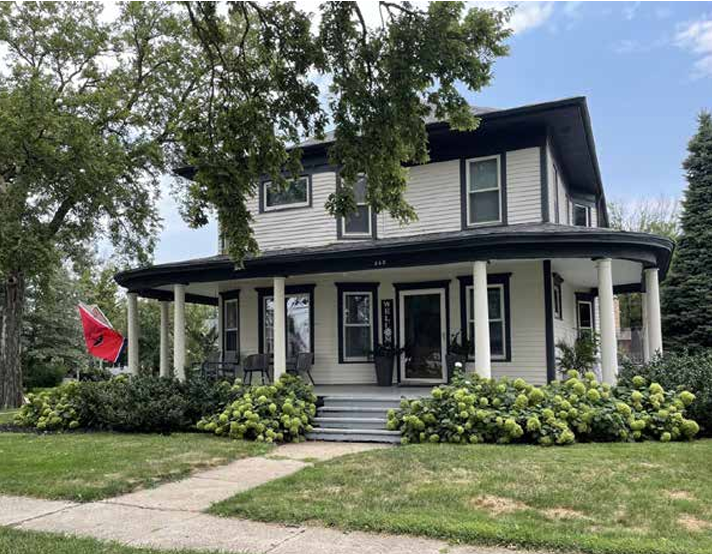
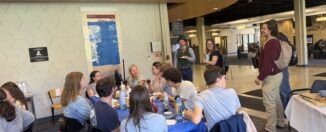
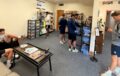
Concordia professor Brent Royuk researches the history of his old home.
Photo: Tobin Beck
This story is featured in the August print edition of the Sower newspaper.
By Leonardo Lopez
Presentations by two Concordia faculty members during Seward’s Fourth of July celebration showed how old photographs, newspaper archives, church records and personal research can uncover local stories that might have been forgotten.
Professor of Physics Dr. Brent Royuk shared the history of his century-old home on Seward Street, which he put together by researching insurance maps, real photo postcards, newspaper archives, title abstracts and records from the Nebraska State Historical Society. During his research, he discovered that one commonly accepted fact about the house, that it was built in 1910, wasn’t accurate. A postcard from 1908 showed the home already standing.
“So, 1908, this is hard evidence. My house was there in 1908,” Royuk said. “Take that, 1910!”
Royuk traced the home’s ownership to Stephen Ralph Douglass and his wife, Jane Douglass. Through her will, Jane Douglass left the home to Seward’s Congregational Church, with one important condition: it had to remain the congregational manse. Royuk explained that the term manse refers to a minister’s residence and it became one of the key words that helped him uncover decades of newspaper references about the property.
If the church stopped using the house as the congregational manse or merged with another denomination, the ownership would return to her heirs.
Years later, those conditions led to a lengthy legal dispute after the home stopped serving as a manse and was used as a nursing home. Royuk said one of the first clues that something unusual had happened was the home’s unusually large title abstract.
“I was able to do a phenomenal amount of research about my house because it was a congregational manse,” Royuk said.
His research showed that the house over the years also hosted 34 weddings before returning to private ownership. Royuk also discovered connections to several well-known Seward families and even learned that former resident, Carolyn Leavitt, later became acquainted with physicist J. Robert Oppenheimer, who led the Manhattan Project in World War II, which developed the first nuclear weapon.
Audience member Michael Ahaye from Virginia said he especially enjoyed learning about the research process behind Royuk’s discoveries.
“I own two 100-year-old houses, so I’ve always been interested in the history and how to find out the history of your house,” Ahaye said. “How he did his research on the house was very interesting.”
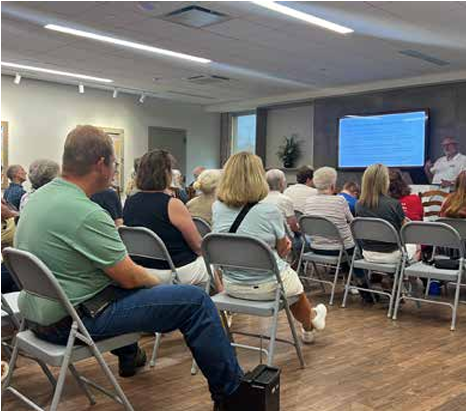
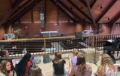
Beck tells about the Black settlers’ history. Photo: Leonardo Lopez.
The second presentation, by Concordia Assistant Professor of Journalism and Political Science Tobin Beck was focused on the history of a person rather than an old house. Beck shared details about the life of Adaline Lindsey, who was born into slavery in Missouri in 1837 as Mildred Adeline Dorsey. According to Beck, who also is chair of Concordia’s department of English, Communication and Theatre Arts, Lindsey secretly learned to read and risked her life during the Civil War by obtaining newspapers and reading them aloud to other enslaved people, giving them hope as they followed news of the Civil War.
Beck reconstructed Lindsey’s story through newspaper archives, church records, cemetery records, county histories and genealogical research, adding details of her life and the lives of other early Black residents whose contributions have been forgotten. After escaping Missouri with her young son, Lindsey crossed the Mississippi River into Illinois before eventually settling in Seward in 1874. Beck said
that she arrived during one of Nebraska’s most difficult years, when grasshopper infestations destroyed crops throughout the region and left many pioneer families struggling.
Despite the challenges faced by the community, Lindsey became an active member of the Methodist Episcopal Church and the Woman’s Christian Temperance Union. Beck said local historian W.W. Cox described her as “the most earnest Christian lady” and “a woman of rare intellectual abilities.”
Beck also introduced the audience to several other members of Seward’s early Black community, including Civil War veteran Braxton Lindsey, who was Adaline’s husband. They were married in Seward in 1884. There also was Annie Bradley, and her sons Harry and James Bradley. Together, their stories showed that Blacks played an important role in Seward’s early history, even though many of their contributions have faded from public memory.
Beck also highlighted the accomplishments of Mary Lindsey, Braxton Lindsey’s daughter, who became the first Black student to graduate from Seward High School in 1890 before later becoming a teacher.
Audience member Gale Simmons from Valentine, Nebraska, said one part of the presentation affected her more than anything else.
“Probably how accepting Seward was to the Blacks,” Simmons said. “That’s probably the thing that stood out the most.”
Simmons said she attended the presentation because of her interest in the history of slavery and wanted to learn more about the experiences of formerly enslaved people in Nebraska.
Although Royuk and Beck presented very different subjects, both speakers showed that history often survives in unexpected places. Whether through old postcards, handwritten wills, cemetery records or newspaper articles, they reminded the audience that many of Seward’s most interesting stories are still in the records.