CUNE student textbook access program heads into second semester, draws mixed reviews
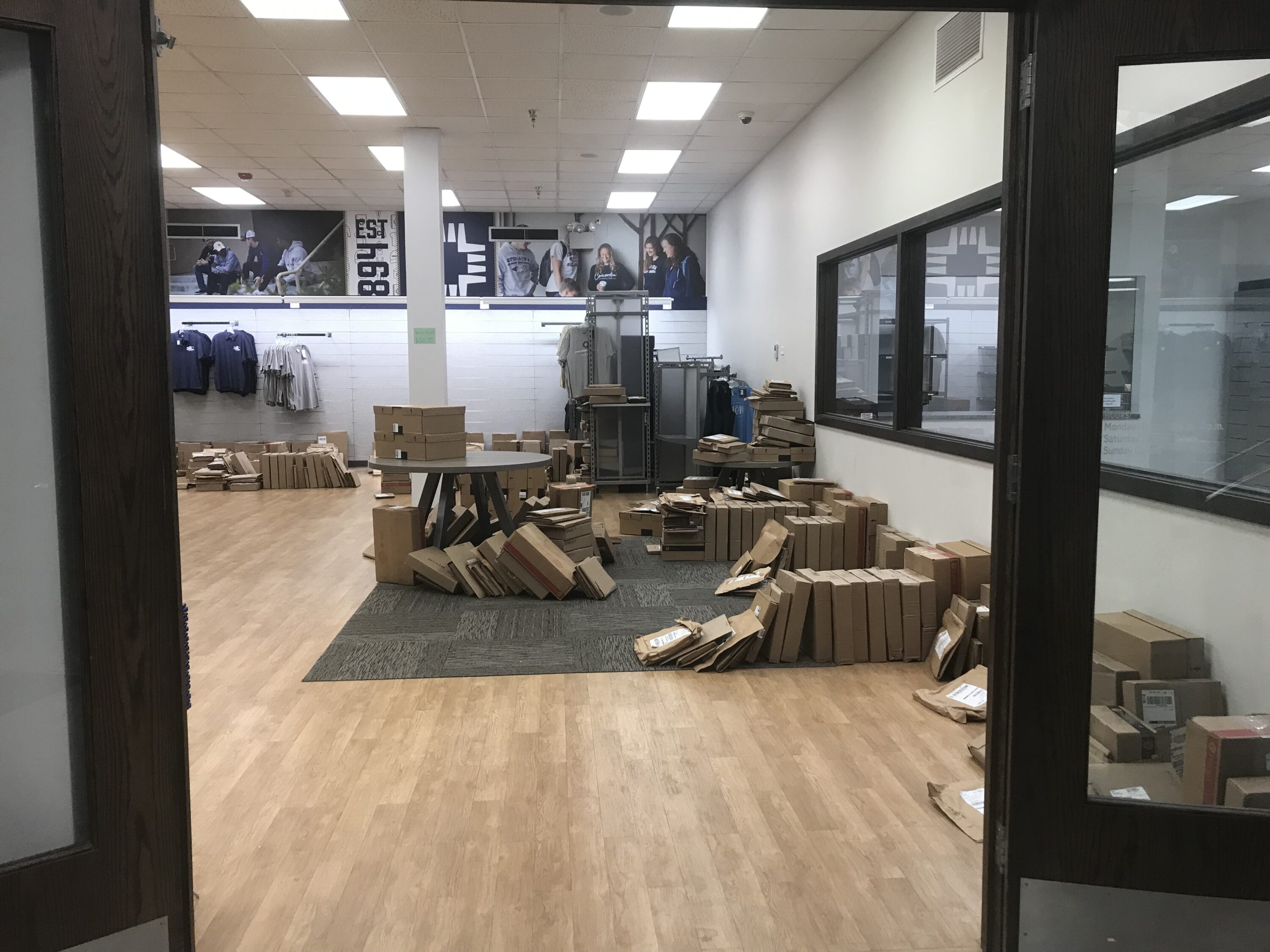
Boxes of student textbooks crowd the bookstore.
Photo credit: Elizabeth Salo
By Elizabeth Salo
Students who opted in to Concordia’s Textbook Access Program faced some issues acquiring their textbooks and gave mixed reviews of the program, which was implemented this spring for its second semester.
Students are automatically opted in to the program, which provides their assigned textbooks for a flat $325 fee for pickup in Concordia’s Fan Shop at the start of the semester. Students who choose to opt-out are not charged the fee, but they must acquire textbooks on their own.
Lawson Fairchild, a sophomore computer science major, chose the textbook program for the financial advantage it provided, but he still had trouble getting his books.
“I calculated it to be more likely to be cheaper than buying all my books individually,” said Fairchild. “It went pretty well up until I had to get my books. I stood in line for about an hour and then they lost them, so I didn’t actually get my books for about a week. But once I did get my books, it was all good.
Allie Hassler, a sophomore education major, also chose to opt-in to the program, but she had difficulty accessing some of her textbooks.
“I’d say the process started off ok, but then for online books, I couldn’t get into one of them until [January 21], and that class obviously started [the week before],” said Hassler. “And for my early childhood class, the book still is not here.”
Naomi Sharkey, a freshman classical liberal arts and music major, chose to opt-in for the sake of convenience, but ended up having similar issues.
Sharkey said that, even though it would be cheaper to order books through alternate sources, “it would be more of a hassle ordering it off of Amazon and such… and [the program] made it a lot easier, even though it cost more.”
However, the textbook pickup process was complicated, she said.
“First semester, [opting in] went fine, but this semester, what happened was, I got here…and went to get my books, and the bookstore was full of boxes, but.. apparently they hadn’t got all of it,” Sharkey said. She said her name was not showing up in the ordering system, and when “they checked in the back, [I had] one book instead of six or eight.”
Despite these hiccups, some students, particularly science majors, do seem to think the textbook program is worth the money.
“The textbook program for me is both easier and less expensive,” said Erin Meyer, a sophomore chemistry major. “As a student in the STEM field, textbooks can often be over $100, and that’s not even including the homework subscriptions that we often need for class or the lab manuals that we end up purchasing.”
Meyer also appreciated the bookstore’s efforts to fix any problems that arose.
“[The process] went very smoothly last semester, but this semester there seemed to be more issues, so that can be frustrating, but they worked hard to get it fixed quickly,” said Meyer.
Sarah Gierke, a sophomore biology and exercise science major, had similar opinions, though she also pointed out the importance of the choice between e-books versus print ones.
“I opted-in both semesters [this year] because, as a STEM major, it is much more cost effective,” said Gierke. “I do wish that we could choose whether it would be a print or an online textbook, because sometimes [in] STEM, it’s very hard to have so many tabs open…I would much rather have a print version.”
Senior Matthew Guilford, a senior secondary education history and theology major, did not opt in to the program, but he did say that it works very well for others.
“I opted out because the cost of the program exceeded what I could get the books for at a thrift store,” said Guilford. “I think [the Textbook Access Program] is nice for the sake of convenience, and especially a great deal if you are in a STEM field or any field that has more expensive textbooks that require you to spend more money than $300…[but] it’s nice that it’s optional and you’re not required to buy into it if you can buy the books separately at a cheaper cost.”
Professors highlighted the convenience of the program as well as its problems.
Professor of English Dr. Gabriel Haley cited the program’s convenience, especially for general education students, even if there are a few minor problems.
“As a professor, I like that the majority of my general education students have the books that they need [at the beginning of the semester],” said Haley. “I have run into problems with some of the books I have tried to select, but nothing major.”
Professor of Biology Dr. Raegan Skelton said there have been more issues in her classes. She said some students have trouble getting their books at the beginning of the semester or getting them in the wrong format.
“I have not really heard very good things from my students,” said Skelton. “It sounds like a lot of it’s been a little bit frustrating, particularly in some of the science courses, that’s a little bit more complicated. Sometimes books are back ordered once the semester starts and we didn’t know that when we adopted [them] months in advance, or physical books that were required ended up being e-books when they needed to be physical books.”
She said that in both semesters it was implemented, some of her students have had problems with the Textbook Access Program.
“So it just seems like there’s a lot of things that need to be worked out in the finer details that you just don’t know until you start something new, but I do know that every semester since we’ve started it, I’ve had issues with students in my classes being able to access their books,” Skelton said.
Skelton also said that the staff of the Fan Shop have been very helpful in the midst of the transition.
“I will speak praises to Dylan Owens over in the Fan Shop,” said Skelton. “[He] has been working really, really hard to make sure that faculty are getting the support they need through this program, that students are getting access…He actually came to my class to talk my students through the options to go through to make sure you can access the book. If we’ve continued having issues, he’s been the liaison to contact Akademos, and make sure that we get the book that we need.”
According to Dylan Owens, the Fan Shop manager and bookstore coordinator, the use of the program went well overall this semester despite some issues. He said he and other staff at Concordia are working to make the program better for future semesters.
“All the books [are] supposed to be singular packages, but some publishers ship separately, which causes a little bit of frustration,” said Owens. “[Overall], compared to last semester, it is a lot better, a lot fewer problems…With everything you do, you’re going to have one-off problems. Already, we’re working on processes to fix some of the issues for next semester…Time was a little bit, I think, tough for people.”
Owens noted long lines in the Fan Shop as students picked up their textbooks at the start of the semester.
“On the first couple days, we had lines out the door, which is a good thing, but I think taking a little extra time to open packages and make sure everyone’s books were in there is a little bit nicer for them,” he said.
Owens also encouraged those who had problems to ask for help if needed.
“I hope that everyone that did stay opted-in has their problems solved, and if not, I would like to know to be able to help them,” said Owens.
Questions about the Textbook Access Program can be directed to Owens at fanshop@cune.edu or 402-643-7400.