Concordia’s museum: It rocks!
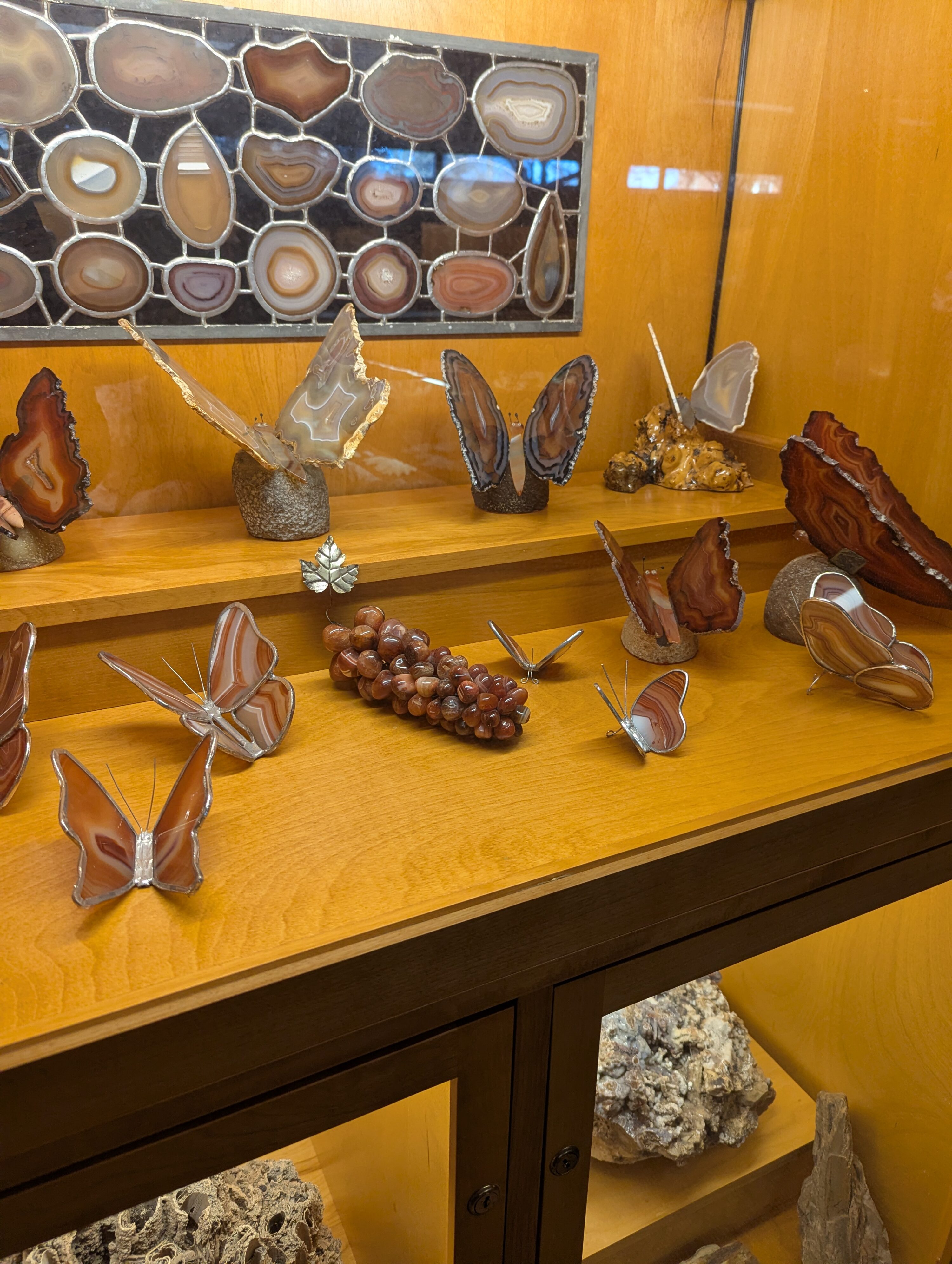
A collection of agate butterflies on display in the Bartels Museum in Link Library.
Photo credit: Mi-Ree Zwick
By Mi-Ree Zwick
The Bartels Museum in the basement of Link Library on Concordia Nebraska’s campus contains a variety of specimens, ranging from geodes to crystals to fossils, with most donated by Walter and Ella Bartels in 1983 and added to until 1989.
Professor of Physics and Bartels Museum Curator Dr. Robert Hermann called it “one of the best collections of stones and gems that you’ll find anywhere in the Midwest.”
Hermann is a professor of physics, astronomy and geology at Concordia, so it seemed natural for him to become curator for the museum.

The Bartels Rock Museum. Photo: Mi-Ree Zwick.
“It’s not a museum that’s trying to tell a particular story where you see the first exhibit, then move onto the second, and so on to learn the history of something,” he said. “It’s a collection, so you wander through it and see what catches your eye.”
Hermann said that every time he walks through the collection something new catches his eye. There are agate, geodes, petrified wood, polished rocks, crystals and fossils. There are more than 75 displays of these specimens, with agate being the most prominent. There are some unique items, like a collection of agate butterflies made from slices of the natural stone that are carved to resemble the insects, as well as a mosaic tabletop, carvings of cork and jade, and more.
The agate displays primarily originate from Brazil and Mexico. One of the most valuable displays is a Brazilian amethyst. A number of fossils also originate from Iowa and Nebraska.
“The Bartels wanted to see their collection of stones, gems and things go to a small college where it can be put on display, used for educational purposes, and have public presentations,” Hermann said
The Bartels had a passion for collecting rocks, spending three decades accumulating the pieces in their collection. The couple lived in Clarinda, Iowa, where they continued to add to their collection until Walter Bartels’ death in 1989. Ella Bartels did not continue to add to the collection after her husband’s death, but enjoyed talking to visitors about it until her death in 1999.
The curator before Hermann, Marvin Plamann, also donated a part of his personal collection to the museum, but the majority of the specimens originated from the Bartels.
“Whether you’re really interested in rocks or gems or not, I think anybody who goes down there will find something beautiful,” Hermann said.
He recommended that students or other visitors go to the museum to clear the mind and leave feeling refreshed.
Sophomore Naomi Mueller said that the first time she visited the Bartels Museum was with her grandmother, a long time ago. She said that it would be a fun break from studying to wander around in the museum.
“I went here for a Visit Day, before I decided to come to Concordia, with my friends. We went down and explored, and saw the amazing crystals,” said Mueller. “Most of the time I don’t [remember it’s there], actually, which is sad.”
Hermann said that many people may not know about the museum. It’s located where few people regularly walk past. “You have to go want to find it,” said Hermann.
Hermann said that past Concordia President Brian Friedrich encouraged people to visit Bartels Museum, describing it as a “hidden gem” every year at commencement because it was a little difficult to find.
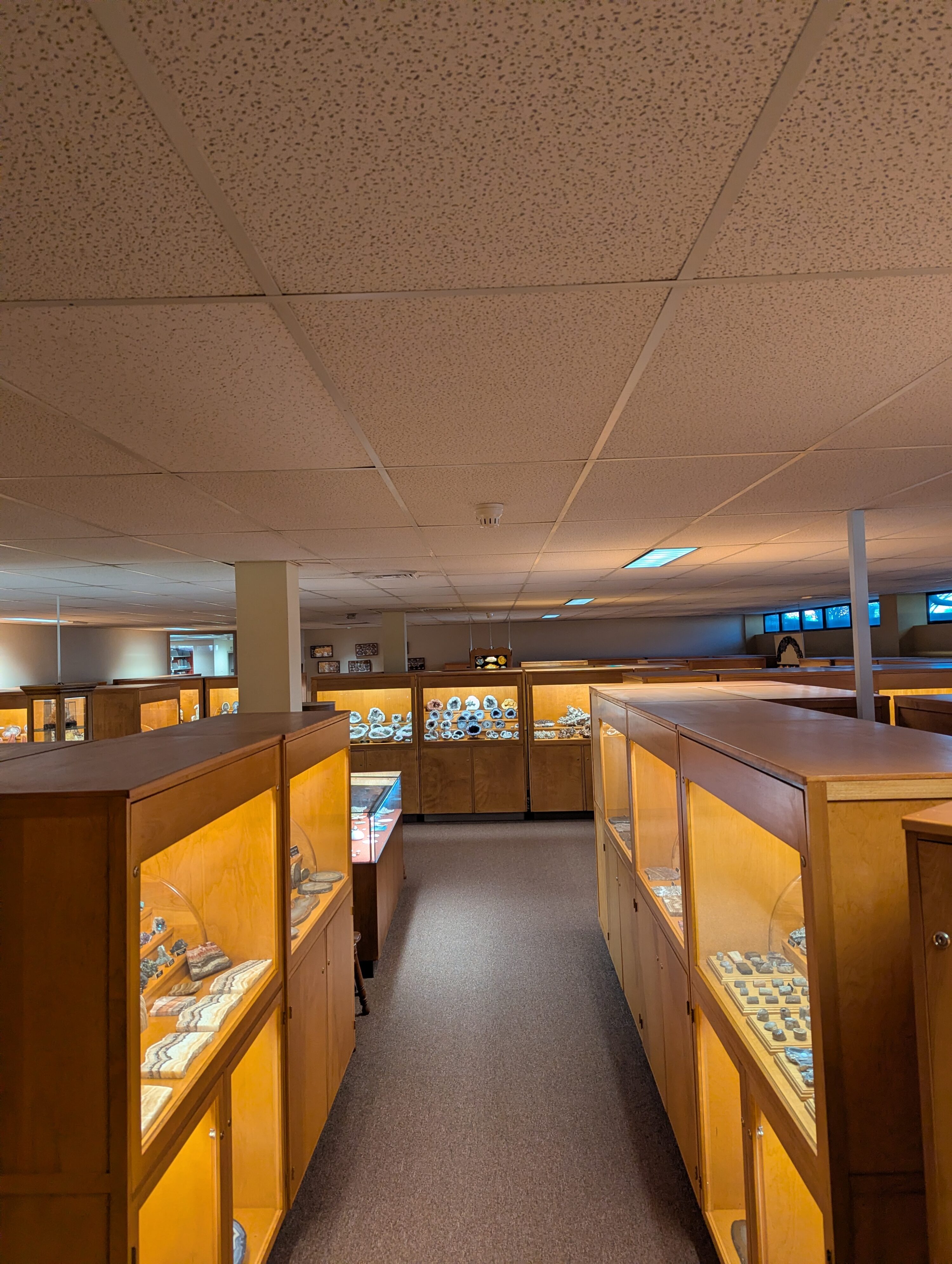
The Bartels Museum features display cases of agate, geodes, crystals, fossils and more. Photo: Mi-Ree Zwick.
Freshman Camryn Beikmann said that “not a lot of people know about it [the museum].”
Beikmann first visited the Bartels Museum when she was in second grade and then returned the next year. She said that she would love to visit the museum, especially with her sister, because they both feel nostalgic when they visit.
Junior Ethan Reynolds took a geology course at Concordia, which led him to take field trips to the museum. Reynolds said that his final project for the class was to create an activity for the museum.
“I created a crossword puzzle to encourage people to look around the museum,” said Reynolds. “So if you go down to the museum, you might do my crossword puzzle.” He said that the museum gave him opportunities to learn more about Nebraska through pieces of the collection found in cornhusker state and was a great spot to see cool rocks.
A while ago, sophomore Madalyn Kohlmeyer was visiting her older sister who was attending Concordia. Kohlmeyer and her siblings decided to visit the museum. The lights are normally shut off when there are no visitors and Kohlmeyer and her siblings could not find the light switch. So they used their phone flashlights.
“You couldn’t really see them [the rocks] when you would shine the flashlight into the cases, so it was just a really funny, slightly creepy experience,” Kohlmeyer said.
She added that even if it was “slightly creepy,” she would love to go through the museum in the dark again with her friends.
Hermann said that the hosts of the collection, the staff of Link Library, have been outstanding. “They take the collection very seriously and so they try to help visitors find it and lead them to it,” he said.
The museum hours are the same as those of the Link Library. The light switch is inside the museum, to the left of the entrance.