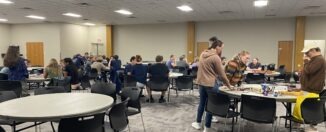

How do CUNE students learn?
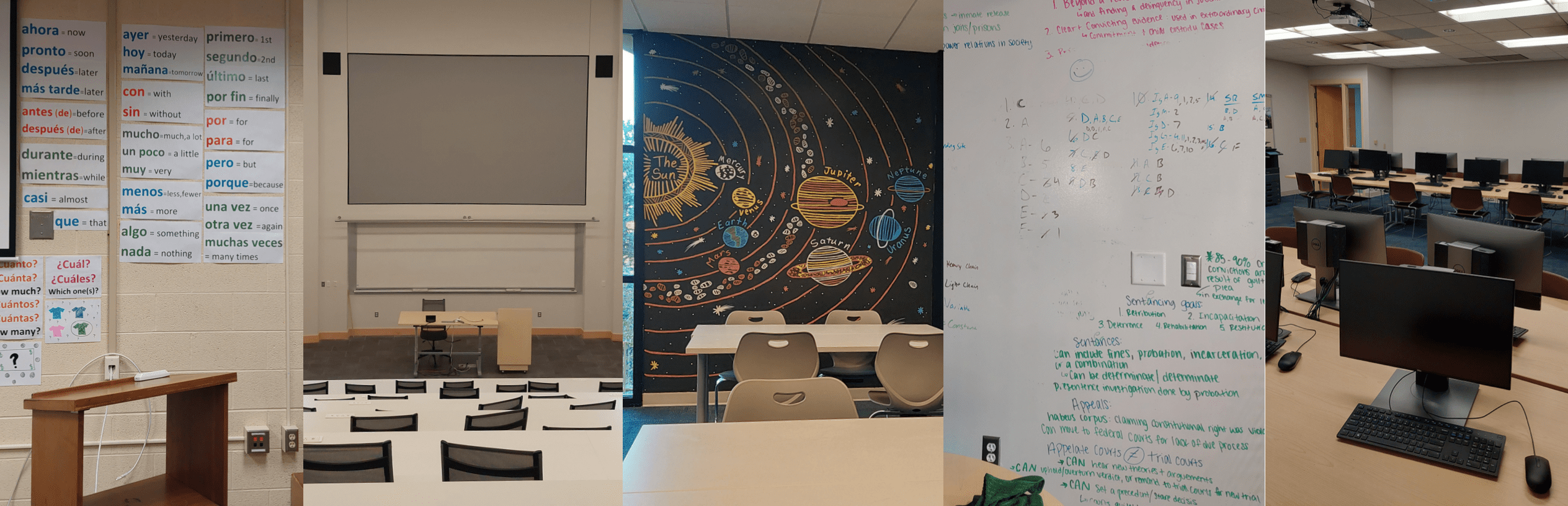
Classrooms and study spots across campus capture diverse teaching, learning, and studying styles at CUNE.
Photo credit: Nora Betts
By Mi-Ree Zwick
This article is featured in the November print edition of the Sower newspaper.
Concordia students have different ways of learning and studying new and old information, inside and outside of the classroom, and they can vary by class.
“If you want to get into the science of it, everyone is technically a kinesthetic learner because you learn by experience, learn by failure and learn by doing,” said senior Caleb Jalas.
The science of learning studies how humans acquire, process and retain knowledge. It allows educators to use evidence-based strategies to improve teaching for students of all ages. This information is built upon research from psychology, neuroscience, education, linguistics and other disciplines.

Dr. Shanna Opfer.
Dr. Shanna Opfer, professor of Education and director of Elementary Education, said learning styles have been a controversial topic among scholars and some claim they are a myth.
“Oftentimes students that are engaging in multiple learning styles versus one often tend to be the most successful [in learning],” Opfer said.
Studies do not offer much about the effectiveness of teaching in a student’s preferred learning style and whether it improves how much students learn. In reality, human brains are programmed to learn through multiple pathways rather than through one pathway.
Opfer said that she still teaches the education students about learning styles. “It’s about the variety and recognizing that there’s lots of different ways to help kids learn,” Opfer said.
Jalas has tried different learning techniques and has experienced many classrooms with a variety of different professor and student personalities. Because of his experiences, he said that his learning style ultimately depends on the class material.
“In a class like astronomy, I learned best from the visuals,” he said. “When I was in my philosophy class, I learned best by not writing the notes down furiously, and in a class like group techniques, you have to be in group projects in order to understand these dynamics.”
Junior April Abbett said that she enjoys lecture-based classes. As a Math and Theater Secondary Education major, she values having clear expectations and detailed instructions.
“I know with my math classes, I really like lecture-based learning, especially if they do a lot of examples,” said Abbett. “If I can physically see what the teacher is doing, what the process of solving this problem is, it makes it much easier for me to understand how to do it on my own later.”
Freshman Gabi Cobian and sophomore Chipper Banks both learn best in the classroom by doing hands-on activities and actively applying their knowledge to a task.
“I think a lot of lectures can be very mind-numbing, and at least for me, it helps me to just be very involved in what we’re doing,” Banks said. He added that he learns best through his mistakes, which are easily identified once applied to a hands-on activity.
Junior Ethan Reynolds said that he learns best through hands-on activities and project-based learning.
“I know a lot of my ed classes do a lot of hands-on, and I think that is very helpful for what I’m learning,” Reynolds said. Education majors go to classrooms to gain real, hands-on experiences, which he appreciates.
On the opposite side of the spectrum, students like freshmen Amelia Ptacnik, Brielle Cook, Liz Wysocki and junior Jackson Lindburg said that they prefer a lecture-based classroom because it allows them to take notes and study them afterward.
“A professor who does discussion and opens up too much to the class, I feel like we don’t get anything done,” said Lindburg.
Cook said she likes taking notes and going over them later. “When there’s questions [in discussions], I get too many opinions,” said Cook. “I just like it when someone tells me, and I can go over it later.”
Wysocki said that in a classroom, she appreciates a mix of teaching styles. While she prefers lecture-based lessons, she likes it when there are class discussions among her peers because she is a verbal processor— someone who needs to talk out loud in order to process information.
“I like the ones where the professors ask us questions, or they have us do some fun activities that make it applicable to our own lives,” Wysocki said. “I’m more engaged in the classroom. I can also remember the information because it’s personal to me.”
Freshman Faith Rohloff said that she learns best in classrooms where the professor or teacher goes out of their way to speak to each student.
“It shows that they really care about what you’re learning, so that makes me more inclined to really take in the information,” she said.
Senior Autumn Consier said that she likes it when professors dive deeper into the topics during lectures, often straying outside of the notes from the slides. “One of the best ways I learn is by listening and then by mimicking after,” she said.
Freshmen Jacob Yakimow and Sophia Roberts said that they enjoy listening to others talk, whether it be professors or their classmates. Like Wysocki, Roberts enjoys being able to discuss the material with her classmates.
“I think I learn best through group assignments, where we can all talk, because it helps to hear from other perspectives,” said Roberts.
However, Yakimow would rather first take notes on a lecture then talk with his classmates afterwards, likely outside of class. “I think it’s easier to just take notes and review that after,” said Yakimow.
Sophomore Audra Poffinbarger said that she likes lecture-based classes, but also appreciates occasional hands-on activities. Freshman Micah Dehne said that he likes any teacher who uses “multiple methods” to teach, includeing lectures, discussions, hands-on activities and more.
Students in Opfer’s classroom complete tasks because she asks them to do it, not because it is their preferred method of learning. She said that she does not know the learning styles students use when they are not in her classroom. When students are outside of her classroom, Opfer guessed that students picked a study method that felt the most comfortable to them. However, she suggested that students should study using multiple methods.
“If someone is just doing one thing because it feels comfortable, they are potentially short-changing their opportunity to see it or learn it in a different way and grow different channels of learning,” said Opfer.
She suggested that students should find more than one way to study the same subject, and use technology tools such as NotebookLM. Opfer herself has multiple ways of studying or analyzing material. She likes to read, annotate and talk to herself or others. Opfer said she also learns by moving.
“While being kinesthetically active, my brain was thinking in a different ways,” Opfer said. “I sometimes had my most thoughtful connections while I was physically active. Do whatever you normally do, try something different to go along with it—don’t abandon it, but add to it.”
Outside of the classroom, most students said that they study well either in quiet places or in slightly noisy places such as a coffee shop or J-Top. Most students said they prefer to work around friends or in a public place so that they can be held accountable. Half of the students said they listen to music while they study.