State of the Campus address answers student questions, addresses campus topics
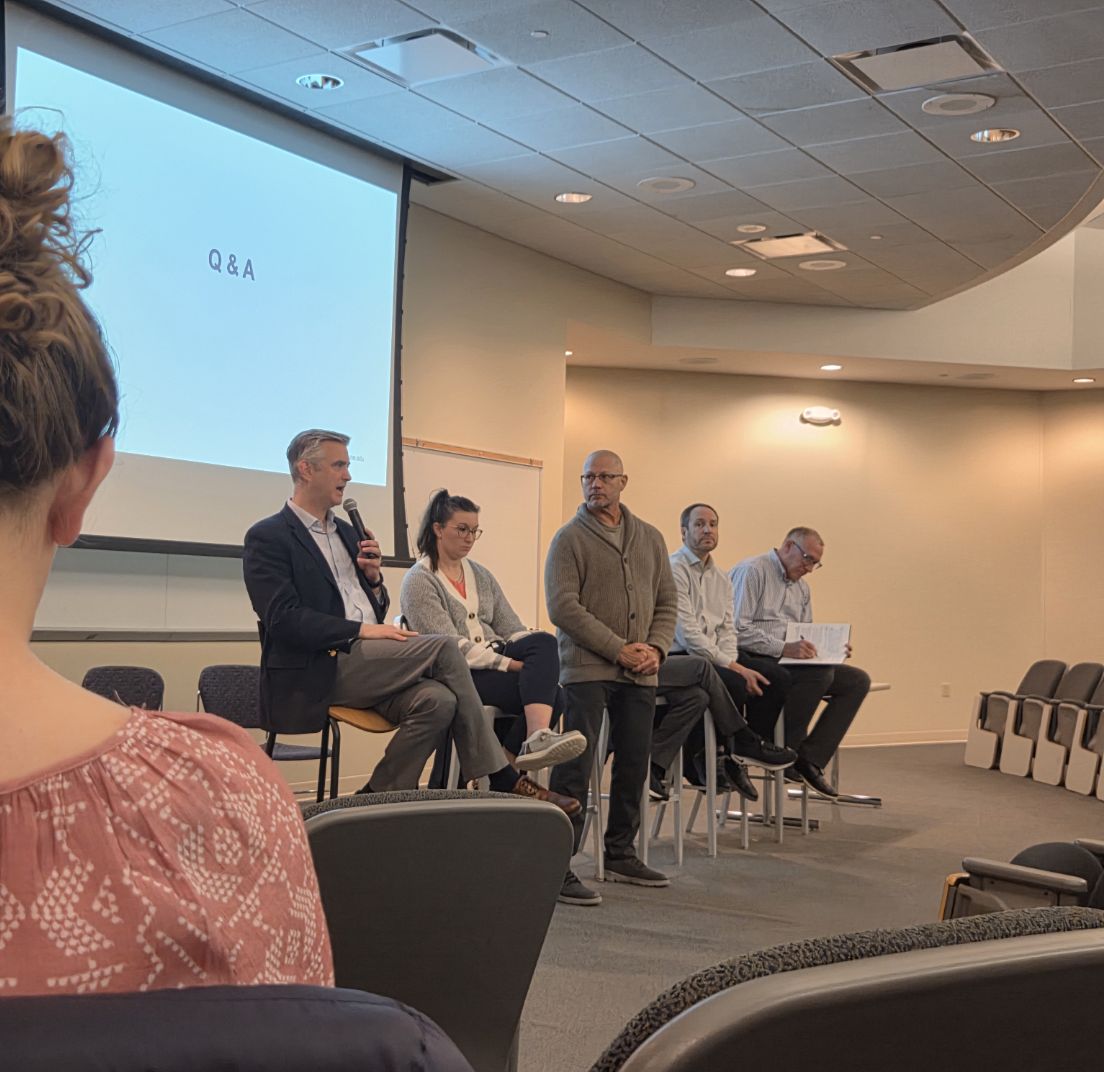
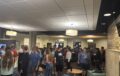
(From left to right): Bernard Bull, Morganne Schreiner, Tim Preuss, Derek Engelbart, and Devin Smith answer questions at the State of the Campus address on Tuesday.
Photo credit: Nora Betts
By Nora Betts
Managing Editor
A Student Senate-sponsored campus address and Q&A session with Concordia’s president and cabinet members on Tuesday informed students about potential campus improvements over the next 15 years, anticipated tuition increases, campus security initiatives and more.
Around 50 students attended the Q&A discussion with university President Bernard Bull and cabinet members Chief Financial Officer Morganne Schreiner; Provost Tim Preuss; Chief Operating Officer Kim Boyce; Vice President for Institutional Advancement Derek Engelbart; and Director of Athletics Devin Smith. Vice President for Student Affairs Gene Brooks was unable to attend.
Future plans
Bull laid out the Campus Master Plan with building projects and campus improvements proposed in phases over the next 15 years.
“We have a strategic plan that we use every five years to kind of direct our new initiatives and projects, and then we have something called the Campus Master Plan,” he said. “This is a plan for what we hope to be able to do in the campus over the next 10 to 15 years. Some are in the zero to five range, some in the five to 10, and some in the 10 to 15.”
Building projects and campus improvements are largely funded by outside donations, not student tuition, Bull said.
“These [plans] are all dependent on us raising money, so it’s very infrequent that we would fund a new building project out of tuition dollars,” he said. “We don’t charge enough to do that. We go out and we raise additional money from donors to help build new buildings like the Dunklau building or the Borland Center.”
Potential changes within the Campus Master Plan include the construction of a standalone chapel, renovations to Link Library, and the addition of a performance hall attached to the west side of the Borland Center for Music and Theatre.
“The five to 10 year range is phase two of the music building, which is a performance hall,” Bull said.
Bull also said Concordia wants to build a baseball field on campus by the 2027 baseball and softball seasons. Concordia’s teams currently share a field with the city of Seward and Seward High School, and team members often miss class when their games are rescheduled or moved because of high school games, he said.
“The cost [of a baseball field], we’re going to have to spend the money one way or the other, whether it was in a shared project with the city or building our own,” he said.
Bull also said the addition of another sports field on the east side of campus could be used for sports like soccer, lacrosse, and flag football.
Potential improvements for the agricultural science program include a space for trade work, located east of David Hall, where the current baseball and softball hitting center is, plus ag labs and classrooms in a new building east of the Walz Human Performance Center.
Other proposed improvements include additional parking spaces across campus and expanded internet coverage to areas outside of buildings.
Bull also said there are potential dorm renovations to Schuelke Hall, Strieter Hall, and Ruth Hall on the west side of campus. Concordia wants juniors and seniors to live on campus, without forcing them to stay using off-campus eligibility restrictions.
“We want to create the kinds of spaces and experiences that would inspire people to want to live on campus,” Bull said. “ And that actually does help with the finances for the whole university because the more students we have living on campus paying room and board, the more it helps keep the cost affordable for everyone else.”
Tuition increases
Students should expect tuition rates to increase by around three to four percent each academic year, Bull said. Tuition increases are most impacted by the cost of faculty and staff salaries and benefits, including things like Concordia Plans pension plans and insurance, he said.
All workers in the schools and churches of the Lutheran Church—Missouri Synod receive pension plans from Concordia Plans, so that “when they retire, in addition to Social Security, they will have a percentage of their income that they will receive every year until God calls them home,” Bull said. The amount that CUNE needs to contribute to the pension plan will continue to go up over the next few years, he said.
“It’s important for us to care for the people that God has called here,” said Bull. “So that’s where part of your tuition dollars goes, and it is the largest line item in the budget—is for the people we serve here.”
Other items impact tuition costs, including rising subscription costs for software programs. Nebraska minimum wage for student workers and some security and Buildings and Grounds staff has increased from nine dollars in 2021 to 15 dollars in 2026. Tuition also reflects the cost of building maintenance and repairs, although new building projects are most often funded by donations rather than student tuition, Bull said.
Bull highlighted donor gifts and Concordia’s endowment fund, and he said that each student would pay $5,000 to $7,000 more in tuition each year if those financial resources did not exist.
Campus security
Boyce said that campus security instituted card access to the Thom Leadership Education Center after 7:30 p.m. this semester as a test run for a campus-wide security update. He said the goal is to require all students and faculty to swipe their Concordia IDs to enter any academic building after 7:30 p.m. to keep campus safe and limit non-students from entering buildings.
“When the sun goes down, it makes it a lot more difficult for us to kind of know, ‘Is everyone that’s supposed to be in that building legitimately supposed to be in that building?’” Boyce said.
He said student safety is Concordia’s top priority, and he wants students to be confident in the Campus Security staff.
“We can’t do anything here successfully if you’re not safe and secure,” said Boyce. “We want to make sure that we have a campus safety and security team that is interacting with you as a student body, that you know, that you have a relationship with, that you can ask questions of, and that you see as a real service to you.”
Mildew in dorms
Boyce said that he received student complaints about mold in dorm buildings, but “there is no mold.” Each time suspected mold was reported, Concordia hired a third-party vendor to test the substance and air quality and found mildew rather than mold.
Mildew becomes a problem after buildings sit dormant over the summer and become humid, Boyce said. The problem is lessened during the school year when more air flows through dorm rooms and hallways and when students have more control over the temperature.
“As you know, some of our dorms are rather old, and they were not built with air conditioning or ventilation systems in them, so they really rely on the activity of the dorms,” he said. “That’s why, most of the time, when students are here on campus, we don’t have a lot of problems.”
Boyce said that when mildew is reported, third-party testing services consistently find that both the air quality of the room and the substance itself are cleaner than the outside air.
Minor for missionary work
Preuss said that Concordia hopes to add a minor for missionary preparation to next year’s academic catalog. The minor, like the Teaching English to Speakers of Other Languages minor, could be attached to any major.
Missionary work is not a called church work position in the LCMS, so it is not a recognized church work program at Concordia, Bull said. A missionary work minor through the Department of History, Geography, Intercultural Studies and Modern Languages would offer “missiology kind of preparatory courses” for interested students, Preuss said.
“We’re hoping to have something that you can attach to a variety of different majors, according to your gifts,” said Preuss.
Next semester’s textbooks
Textbook requirements for the Spring 2026 semester are now available to view on Concordia’s Textbook Access Program website, www.cune.vitalsource.com, said Boyce.